
 +86 15898932201
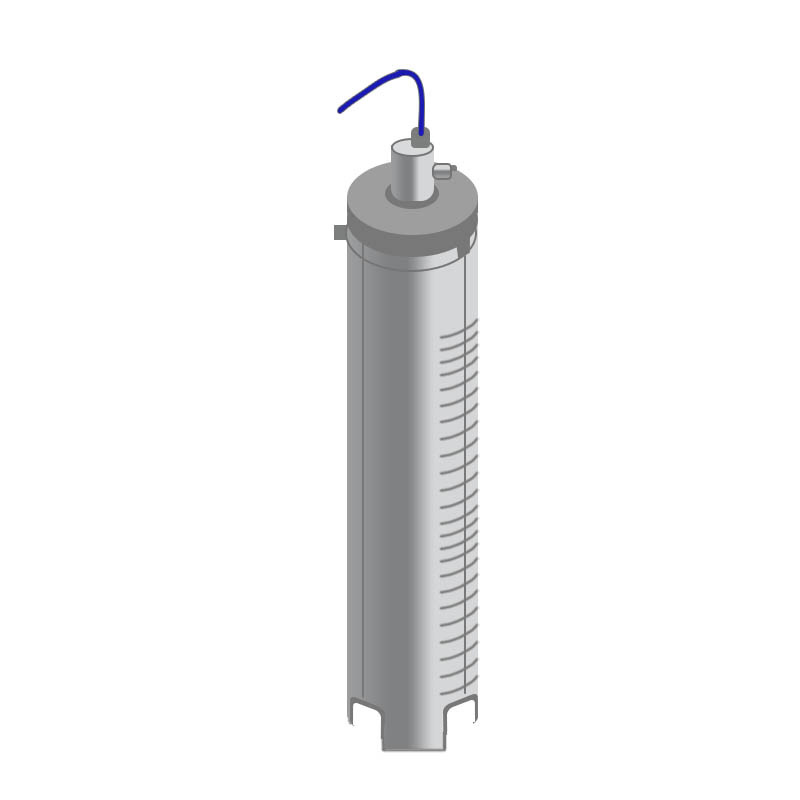
Dam seepage monitoring is a high-precision instrument specifically designed for open channel flow measurement. It combines a magnetostrictive level sensor with a standard hydraulic weir structure to achieve non-contact continuous water level measurement. It features high resolution, good stability, fast response, and maintenance-free operation, making it suitable for long-term monitoring of water level and flow changes in weirs and channels of rivers, lakes, and reservoirs.
The core working principle of Dam seepage monitoring is based on precise level sensing using the magnetostrictive effect. The instrument consists of a magnetostrictive level sensor and a standard weir/channel structure. The sensor portion includes a waveguide and a magnetic float that floats with the water level. During operation, the sensor sends a current pulse along the waveguide. This pulse interacts with the float's magnetic field at the float's location, generating a torsional stress pulse. By accurately measuring the time difference between the current pulse's emission and the stress pulse's return, the precise position of the float, i.e., the water level elevation, can be calculated. This process achieves non-contact continuous water level measurement.
The instrument's technological advantages lie in its high precision and long-term reliability. Magnetostrictive technology itself has extremely high resolution, capable of sensitively capturing minute changes in water level. The entire measurement system is a solid-state structure with no mechanically worn parts, ensuring its long-term stability and reliability. The instrument exhibits excellent linearity and fast response, reflecting dynamic changes in water level in real time. Due to its stable measurement benchmark, it typically requires no recalibration after proper installation and eliminates the need for complex periodic maintenance, making it ideal for long-term, unattended automated monitoring in remote or inaccessible locations.
The instrument's application value lies in providing accurate and continuous flow data for hydrological monitoring and water conservancy project management. By installing it on standard weirs such as triangular and rectangular weirs, the system can automatically convert measured water level elevations into instantaneous flow rates using appropriate weir flow formulas (such as those in ISO 1438). Therefore, it is widely deployed in open channel sections requiring flow measurement, such as rivers, irrigation canals, reservoir spillways, and sewage treatment plant outlets. The obtained continuous water level and flow data serve as a crucial foundation for water resource allocation, flood warnings, soil and water conservation assessments, and engineering safety monitoring, making it a key device for achieving information-based and refined water conservancy management.
Article address:https://www.sqqx.net/en/news/808.html