
 +86 15898932201
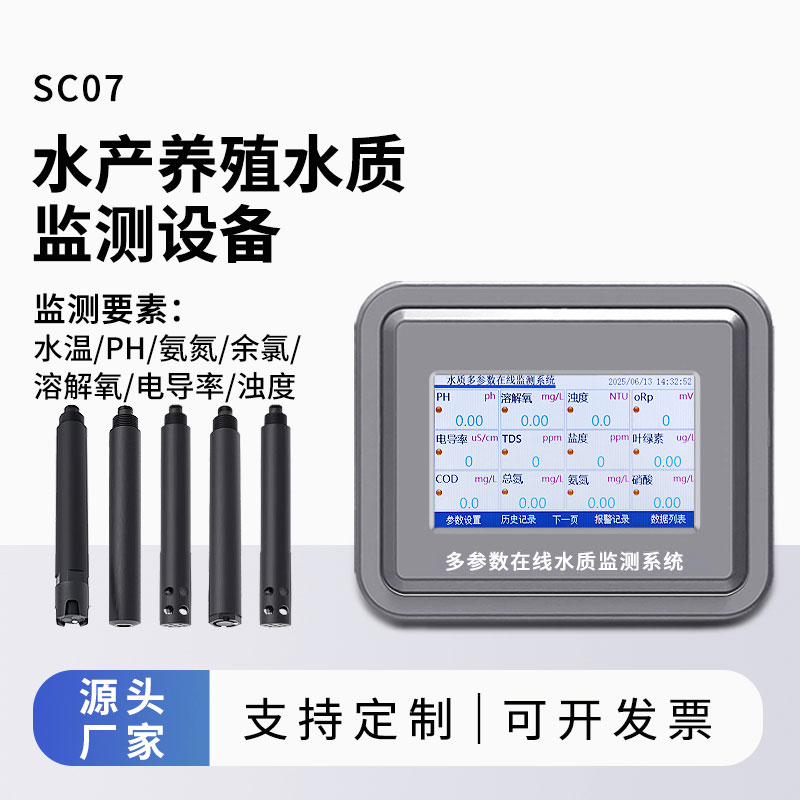
Aquaculture Water Quality Monitoring is capable of detecting parameters such as water temperature, conductivity, pH, ammonia nitrogen, dissolved oxygen, and turbidity. It is suitable for use in industrial wastewater management, aquaculture, and river and lake surveys, enabling water quality testing in both field and laboratory environments. Featuring rapid, simple, and accurate measurement capabilities, the device assists users in analyzing water body conditions and mitigating risks associated with aquaculture.
Aquaculture Water Quality Monitoring is a multi-parameter testing device designed for both field and laboratory water quality analysis, capable of simultaneously measuring six key indicators: water temperature, conductivity, pH, ammonia nitrogen, dissolved oxygen, and turbidity. These parameters encompass the core elements of water quality in aquaculture settings; specifically, dissolved oxygen levels directly impact the respiratory metabolism of aquatic organisms, while ammonia nitrogen concentrations relate to water toxicity and aquaculture safety. pH and conductivity reflect the chemical environment of the water, turbidity characterizes the content of suspended solids, and water temperature serves as a fundamental condition determining biological growth rates.
Aquaculture Water Quality Monitoring features an integrated design combining the sensor and a portable host unit, thereby simplifying the operational workflow. Once the user immerses the sensor probe into a water sample, the instrument automatically initiates the measurement process and displays the data on the screen, with each measurement cycle requiring only a short duration. The device includes a built-in calibration function, allowing users to perform periodic calibrations using standard solutions to ensure measurement accuracy. Compact and lightweight, the complete unit comes equipped with a portable carrying case, making it suitable for use in various settings—whether at the edge of a pond, along a riverbank, or on a laboratory workbench.
In field scenarios, Aquaculture Water Quality Monitoring can be utilized for routine inspections of aquaculture ponds, water quality monitoring in rivers and lakes, and general field water quality surveys. Users can carry the device to perform on-site testing at various locations to obtain real-time data, eliminating the need to collect water samples and transport them back to a laboratory, thereby significantly shortening the testing cycle. In laboratory settings, the device facilitates the batch testing of samples or comparative analyses; data can be stored and exported, simplifying record-keeping and tracking processes.
The device also offers significant practical value in the fields of industrial wastewater management and municipal engineering. It can be effectively utilized to perform water quality testing for industrial effluent discharges, as well as for monitoring and controlling water quality at various stages of the wastewater treatment process. For aquaculture practitioners, the regular monitoring of parameters—such as water temperature, dissolved oxygen, and ammonia nitrogen—enables the timely detection of deteriorating water quality trends. This allows for the proactive implementation of measures—such as aeration, water exchange, or pH adjustment—thereby effectively preventing losses in production caused by sudden shifts in water quality. By providing intuitive and quantitative water quality data, this device serves as a foundational basis for aquaculture management, environmental assessment, and water quality regulation.
Article address:https://www.sqqx.net/en/news/860.html