
 +86 15898932201
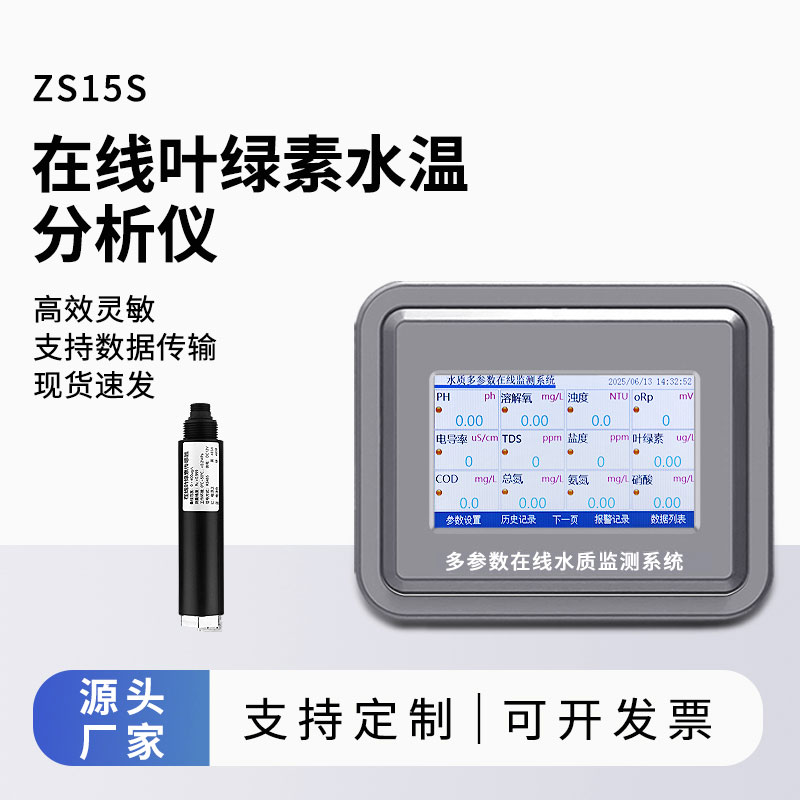
Chlorophyll Analyzer employs fluorescence detection technology, featuring a measurement range of 0–400 µg/L, a measurement accuracy of R² > 0.999, and a resolution of 0.01 µg/L. The device features a built-in self-cleaning brush head and temperature compensation function; powered by a proprietary operating system, it can rapidly perform in-situ detection of chlorophyll parameters in water bodies. It is suitable for various applications, including aquaculture, surface water monitoring, and scientific research institutions.
Chlorophyll Analyzer represents a class of high-precision water quality analysis devices based on the principle of fluorescence detection, primarily used for the rapid measurement of Chlorophyll *a* concentrations contained within phytoplankton in water bodies. The fluorescence method operates by utilizing a light source of a specific wavelength to excite chlorophyll molecules, causing them to emit fluorescence at a corresponding specific wavelength; the Chlorophyll *a* content is then determined by detecting the intensity of this emitted fluorescence. This method offers several advantages—including high sensitivity, rapid response speed, and the elimination of the need for sample pre-treatment—thereby significantly reducing detection time compared to traditional spectrophotometric methods.
In terms of measurement performance, this series of instruments covers a Chlorophyll *a* measurement range of 0–400 µg/L, achieving a measurement accuracy of R² > 0.999 and a resolution of 0.01 µg/L. For certain models, the detection limit can be as low as 0.5 ppb (or 0.1 µg/L), enabling them to meet diverse monitoring requirements ranging from pristine water bodies to eutrophic waters. To enhance measurement accuracy, some devices feature a dual-channel design that simultaneously measures turbidity alongside Chlorophyll *a*; the Chlorophyll *a* data is then automatically corrected based on the turbidity readings, effectively eliminating interference to the fluorescence signal caused by suspended solids in the water.
Regarding structural design, Chlorophyll Analyzer has been engineered with full consideration for the complexities of field operating environments. The device is equipped with a self-cleaning brush head that periodically performs mechanical cleaning of the sensor's optical window, thereby preventing signal attenuation caused by biofouling and dirt accumulation. A temperature compensation function ensures the stability of measurement results across varying water temperatures. With a probe-style design boasting an IP68 protection rating, the device can be directly submerged into water bodies for in-situ measurement, eliminating the need to collect water samples for subsequent laboratory analysis. Portable models feature a handheld design with a built-in high-capacity lithium battery, offering a continuous standby time of over one month. When paired with a portable carrying case, these units are fully equipped to meet all requirements for on-site field testing.
In terms of the operating system, select products feature a proprietary, self-developed OS and are equipped with a touch display screen measuring 5 inches or larger, offering a clean and intuitive user interface. Measurement times can be reduced to under 5 seconds, thereby significantly boosting detection efficiency. Regarding data storage capabilities, the device can store over one million sets of measurement data and supports both USB and serial port data transmission functions, facilitating easy data export and subsequent analysis.
In terms of application fields, the Chlorophyll Analyzer is widely utilized for water quality monitoring in aquaculture, enabling farmers to timely assess phytoplankton biomass in water bodies and prevent water quality degradation caused by excessive algal blooms. In the realm of surface water monitoring, the device is suitable for routine monitoring and algal bloom early warning systems in various water bodies, including rivers, lakes, and reservoirs. Research institutions and universities employ the device for both field surveys and laboratory analyses across disciplines such as aquatic biology, aquatic ecology, and microalgal physiology. Furthermore, this type of device finds application in diverse scenarios, including drinking water source monitoring, marine monitoring, and ecotoxicology research.
Article address:https://www.sqqx.net/en/news/862.html