
 +86 15898932201
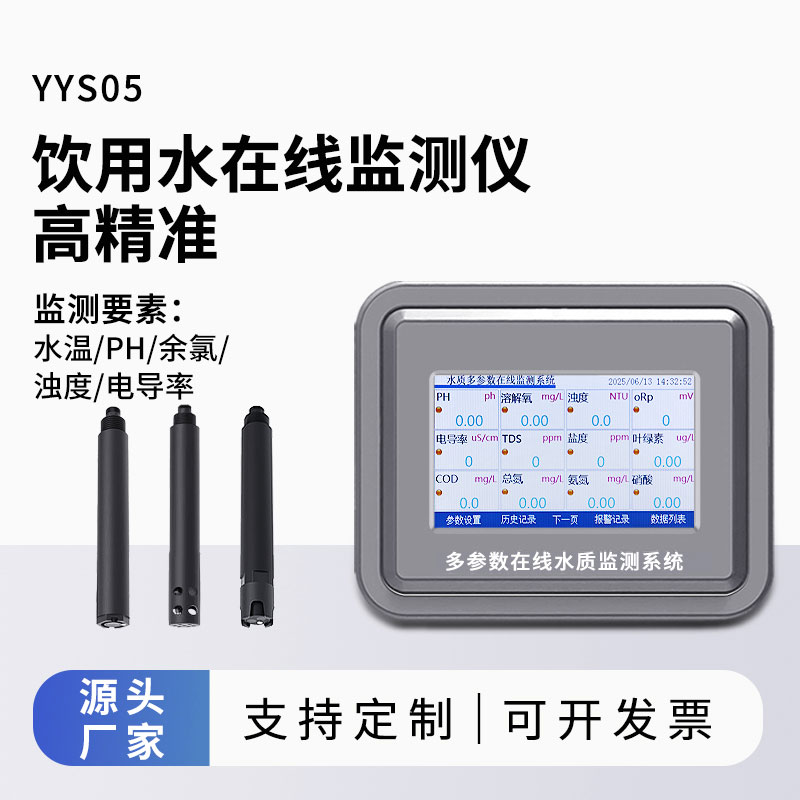
Online Drinking Water Monitoring Equipment facilitates the online monitoring of key water quality parameters—including residual chlorine, pH, turbidity, conductivity, and water temperature. It is ideally suited for deployment in scenarios such as water treatment plants, the extremities of distribution networks, secondary water supply systems, and rural drinking water facilities, enabling real-time data acquisition and remote monitoring of water quality.
Online Drinking Water Monitoring Equipment is an instrumentation system capable of continuously and automatically monitoring critical water quality indicators within a water body; its primary monitoring parameters include residual chlorine, pH value, turbidity, conductivity, and water temperature. This class of device employs a sensing technology that combines electrochemical and optical methods. Specifically, the residual chlorine sensor utilizes either the constant potential method or the polarographic principle to determine chlorine concentration by measuring the electrical current generated by electrode reactions. The turbidity sensor operates based on the principle of 90° scattered light, using infrared or white light to illuminate a water sample and measure the changes in light intensity caused by suspended particulate matter. pH and conductivity are measured directly using a glass electrode and a conductivity electrode, respectively. Once these sensors convert the water quality parameters into electrical signals, the data is processed by a dedicated acquisition module and subsequently uploaded to a management platform via an RS485 interface or a wireless communication module.
In terms of structural design, Online Drinking Water Monitoring Equipment typically adopts a modular architecture, integrating the measurement units for various parameters into a single, unified flow cell. This design results in a compact device footprint and facilitates easy installation, while also allowing for the flexible combination of measurement parameters to meet specific monitoring requirements. Some models are further equipped with an automatic cleaning function—utilizing either air purging or mechanical brushing—to maintain the cleanliness of the sensor surfaces and extend maintenance intervals. Regarding power supply, for monitoring sites located in outdoor or remote areas, certain products employ a hybrid power solution combining solar panels with rechargeable batteries, thereby effectively resolving the operational challenges associated with deploying equipment in locations lacking access to mains electricity.
The application scope of Online Drinking Water Monitoring Equipment spans the entire water supply chain—from the source all the way to the tap. Within water treatment plants, these devices are installed at raw water intake points, throughout the water treatment process stages, and along the treated water outflow pipelines; here, they serve to monitor fluctuations in raw water quality, assess the efficacy of flocculation and sedimentation processes, and verify the appropriateness of disinfectant dosing levels. Within water supply networks, these devices are strategically deployed at booster pump stations, network nodes, and terminal points to continuously monitor residual chlorine decay and turbidity fluctuations. This enables water utilities to assess water quality stability and promptly detect instances of pipeline contamination. In secondary water supply facilities and rural drinking water projects, such equipment facilitates the remote monitoring of water quality in rooftop tanks and reservoirs, thereby preventing water quality degradation caused by improper storage practices.
Through continuous online monitoring, the Online Drinking Water Monitoring Equipment system rapidly records real-time trends in water quality parameters, issuing early warnings before indicators exceed the limits prescribed by the *Sanitary Standard for Drinking Water* (GB 5749). This predictive warning capability allows water treatment plant operators to make timely adjustments to disinfection processes or pipeline flushing protocols, resolving water quality issues proactively—before user complaints arise—and providing essential technical support for ensuring drinking water safety from source to tap.
Article address:https://www.sqqx.net/en/news/864.html