
 +86 15898932201
Crack Detection Sensor features a measurement range of 0–1000 mm, an accuracy of ±0.02% F.S., and a response time of 1 second. It employs a combination of a draw-wire sensor and a tensioned wire mechanism to measure linear displacement. Designed for monitoring the relative displacement of surface fissures, unloading cracks, structural cracks in buildings, and similar features, it provides precise data support for early warning systems regarding landslides and rockfalls.
Crack Detection Sensor is a high-precision sensor that measures the linear displacement of an object via a draw-wire mechanism. It consists of a draw-wire, a winding drum, a spring mechanism, and an angle sensor. As the draw-wire extends or retracts in response to the movement of the monitored object, the winding drum rotates, driving the angle sensor to convert the mechanical displacement into an electrical signal output, thereby enabling the measurement of displacement. This device is primarily utilized for the precise monitoring of relative displacement in surface fissures, unloading cracks, and cracks within buildings or other structures; it is capable of capturing minute changes in real-time, providing critical data for early warning systems regarding geological hazards such as landslides and rockfalls.
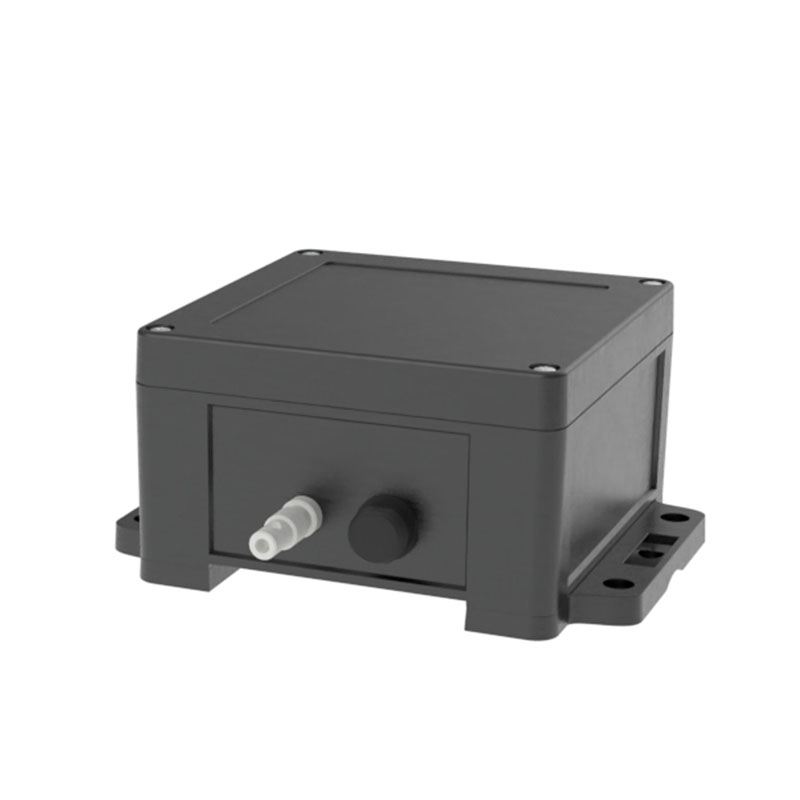
In terms of structural design, the Crack Detection Sensor features an enclosure constructed from ABS engineering plastic, offering excellent weather resistance and corrosion resistance. An internal precision spring ensures that the draw-wire remains constantly tensioned, thereby eliminating backlash errors. The draw-wire typically consists of a stainless steel cable coated with a wear-resistant material, guaranteeing reliability during long-term outdoor deployment. The integrated design—combining the sensor with the draw-wire—establishes a flexible connection between the measurement mechanism and the monitored object; this approach not only ensures measurement accuracy but also prevents the imposition of structural constraints on the monitored object that might otherwise result from a rigid connection.
Regarding technical specifications, this displacement sensor offers a measurement range of 0–1000 mm, capable of meeting monitoring requirements ranging from minute fissures to significant displacements. It achieves an accuracy of ±0.02% of full scale—meaning that at its full range of 1000 mm, the maximum error does not exceed 0.2 mm—enabling the capture of even subtle changes in cracks. Furthermore, with a response time of just 1 second, it facilitates near real-time data acquisition. With a supply voltage range of 12 to 24 VDC and a power consumption of just 0.4 watts, the device is ideally suited for battery- or solar-powered applications. It utilizes the standard Modbus-RS485 communication protocol, allowing for direct integration into automated monitoring systems to facilitate multi-device networking and remote data transmission.
In terms of application scenarios, the Crack Detection Sensor is widely deployed in fields such as geological hazard monitoring, structural health monitoring of buildings, and deformation monitoring of tunnel surrounding rock. In landslide monitoring, the instrument is installed spanning surface fissures to record changes in fissure width in real time. Should the rate of deformation accelerate beyond a predefined threshold, the system issues a warning alert, thereby gaining critical time for personnel evacuation and emergency response measures. In building monitoring applications, the device is installed on either side of existing cracks to precisely detect displacement resulting from factors such as temperature fluctuations and structural settlement. For monitoring mine slopes and high-gradient road embankments, a multi-point array of displacement sensors can be deployed to create a comprehensive deformation monitoring profile, reflecting the dynamic evolution of slope stability.
As requirements for geological safety and structural health monitoring continue to rise, the Crack Detection Sensor—characterized by its high precision, low power consumption, and ease of networking—has emerged as a vital component within monitoring networks, providing essential data support for engineering safety and disaster prevention and mitigation efforts.
Article address:https://www.sqqx.net/en/news/857.html