
 +86 15898932201
Online conductivity meter employs the contact electrode method to measure water conductivity parameters, featuring a measurement range of 0 to 10,000 µS/cm, an accuracy of ±1.5%, and a resolution of 1 µS/cm. It is suitable for applications involving the measurement of acid, alkali, and salt concentrations in surface water, as well as in tap water systems, wastewater treatment facilities, and rivers; thus, it serves as an essential tool for water quality monitoring and industrial water treatment.
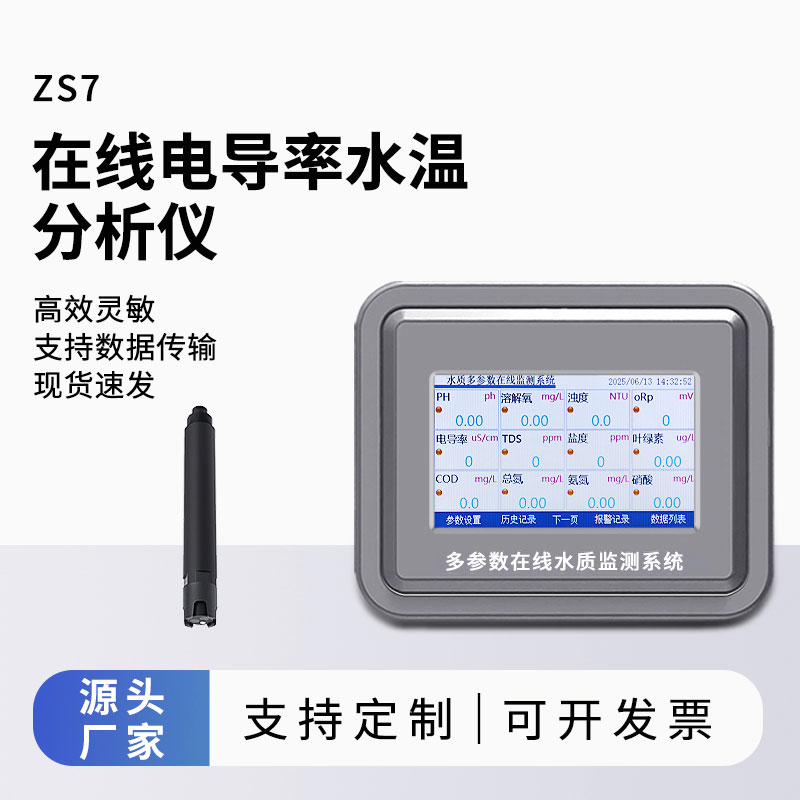
Online conductivity meter is a water quality analysis instrument based on the principles of the contact electrode method, designed to measure the concentration of dissolved ions and the electrical conductivity of water. Conductivity refers to a substance's capacity to transmit electric current; it reflects the extent of electrolytes present in the water. By detecting the water's conductivity, parameters such as purity and concentration can be determined. The instrument consists of two main components: a host unit and a conductivity electrode. The electrode houses an internal temperature sensor to facilitate automatic temperature compensation. During operation, the two-pole conductivity electrode applies a voltage across the water sample to induce a measurable current. By utilizing the measured voltage and current values—combined with a temperature compensation algorithm specific to water samples—the instrument calculates the conductivity value. Measurement results are output in units of microsiemens per centimeter (µS/cm) or millisiemens per centimeter (mS/cm). The instrument offers a measurement range of 0 to 10,000 µS/cm, a measurement accuracy of ±1.5%, and a resolution of 1 µS/cm, while also boasting a temperature measurement accuracy of ±0.1°C.
In terms of functional configuration, Online conductivity meter typically features a portable design equipped with a built-in, high-capacity rechargeable lithium battery, enabling users to perform water quality testing conveniently—whether in the field or in a laboratory—at any time. The instrument runs on a proprietary operating system developed in-house, offering simple operation, stable performance, accurate measurements, and a wide detection range, along with an automatic temperature compensation function. Certain models utilize fully digital electrode detection technology. The device features a 3.5-inch color LCD screen and is equipped with an RS485 interface supporting the Modbus RTU protocol; optional features include USB connectivity, a 4G communication module, and GNSS positioning capabilities. With an internal storage capacity of 8 GB, the device can store approximately 280 million data entries for a single parameter; it supports the review of historical data, and data can be exported to a computer as an Excel spreadsheet via a USB connection. The main unit features an IP65 protection rating, while the electrode holds an IP68 rating, enabling the device to meet the rigorous dustproof and waterproof requirements of field operations. The instrument supports switching between Chinese and English interfaces, and its purely button-based operation ensures unimpeded functionality, even when operated with wet hands.
The Online conductivity meter is suitable for measuring the conductivity of various water bodies and finds particularly extensive application in determining the acid, alkali, and salt concentrations of surface waters. This instrument can be utilized for water quality monitoring in municipal waterworks, process control in wastewater treatment plants, and environmental monitoring of rivers and lakes. In the industrial sector, conductivity meters are employed for the continuous online monitoring of high-purity water—such as boiler feedwater and steam condensate. Within the food and drinking water industries, this instrument serves as essential testing equipment for food processing plants and water treatment facilities seeking to obtain QS and HACCP certifications. Handheld conductivity meters are applicable across a wide range of settings—including industrial, environmental protection, food processing, scientific research, and educational environments. The product line encompasses various models—including pen-type, portable, laboratory benchtop, and online-monitoring units—designed to meet the specific measurement requirements of diverse application scenarios.
Article address:https://www.sqqx.net/en/news/873.html