
 +86 15898932201
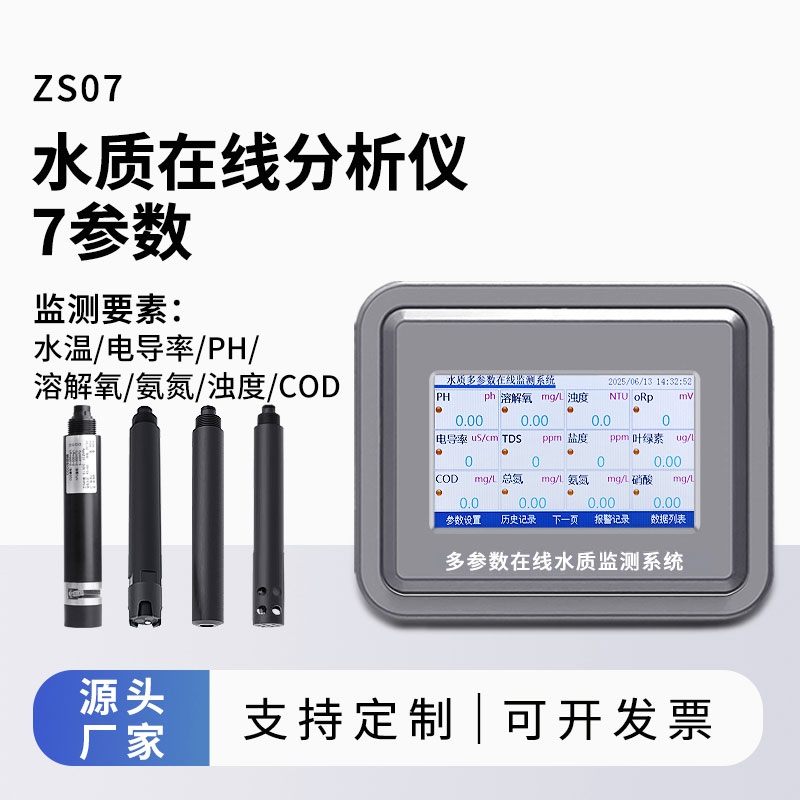
Shandong Fengtu is a manufacturer of online wastewater monitoring equipment, specializing in the production of multi-parameter water quality analyzers capable of continuously monitoring conductivity, pH, dissolved oxygen, ammonia nitrogen, turbidity, COD, and water temperature. Designed for field environments, these devices deliver stable measurements and possess strong anti-interference capabilities, enabling users to effectively monitor the status of wastewater quality.
Online wastewater monitoring equipment is utilized to record—in real-time—key parameters within water bodies, such as conductivity, pH levels, dissolved oxygen, ammonia nitrogen, turbidity, chemical oxygen demand (COD), and water temperature. This capability assists wastewater treatment plants and industrial enterprises in tracking changes in wastewater quality and making timely adjustments to their treatment processes. Compared to traditional laboratory sampling and testing, such equipment offers greater speed and efficiency; it can operate continuously at discharge points, thereby providing consistent data support for effective water quality management. Selecting a reliable manufacturer of online wastewater monitoring equipment is a prerequisite for ensuring both the accuracy of monitoring data and the operational stability of the system.
Shandong Fengtu is a manufacturer of online wastewater monitoring equipment headquartered in Weifang City, Shandong Province. The company's headquarters is located at No. 155 Guangdian Road, High-tech Zone, Weifang City—specifically within the Optoelectronic Industry Accelerator (Phase I). Fengtu is dedicated to the R&D, manufacturing, sales, and service of water quality monitoring equipment, boasting a complete and integrated production chain. Its online wastewater quality monitoring instruments are capable of tracking a wide array of parameters, including water temperature, COD, ammonia nitrogen, pH, residual chlorine, dissolved oxygen, conductivity, turbidity, and ORP. The company's WS10 online wastewater quality monitoring instrument, for instance, integrates corresponding sensors and measurement modules to rapidly and accurately record key parameters within water bodies. Furthermore, it supports multi-parameter expansion and utilizes the MODBUS-RTU communication protocol via an RS485 interface; historical monitoring data can be exported locally or accessed remotely through an IoT platform.
Online wastewater monitoring equipment is required to operate continuously over long periods in demanding field environments—such as at wastewater discharge points, within treatment plants, or at river cross-sections—necessitating high standards for both device stability and anti-interference capabilities. Taking Fengtu’s FT-ZS07 model as an example: this device employs a modular integrated design that allows for the simultaneous acquisition of multiple water quality parameters. Its sensor probes feature an automatic cleaning function, thereby reducing the frequency of manual maintenance required. Additionally, the device's housing is designed to be both waterproof and dustproof, ensuring reliable and continuous operation even in outdoor environments. When concentrations of COD or ammonia nitrogen exceed permissible limits, the system utilizes wireless communication to transmit a pre-warning to the monitoring center, thereby assisting personnel in promptly identifying and investigating abnormal discharges to prevent the spread of pollution. This equipment has been successfully deployed in various settings, including industrial wastewater discharge outlets, hospital sewage treatment facilities, and municipal sewage networks.
Within the sector of online wastewater monitoring equipment, in addition to Fengtu, there are numerous other specialized manufacturers. The products offered by these various manufacturers differ in terms of the types of monitoring parameters supported, measurement ranges, and data transmission methods. When selecting equipment, users should first determine the specific parameters requiring monitoring—based on the actual water quality conditions at the discharge point and relevant environmental regulatory requirements—and subsequently choose the appropriate equipment configuration and manufacturer. The implementation of an online wastewater monitoring system typically comprises three key stages: sensor installation, data acquisition and transmission, and monitoring platform commissioning. During on-site installation, particular attention must be paid to ensuring the representativeness of the sampling points and to the regular calibration of sensors, in order to guarantee the accuracy and validity of the monitoring results.
Article address:https://www.sqqx.net/en/news/878.html